Boppard and Rüdesheim October 11, 2013

We skipped breakfast this morning and headed out for an early morning walk in the rain through central historic Boppard. Boppard is home to a Carmelite Church. In a niche in the exterior wall is a Madonna of the Grapes. Each year at the beginning of the season, the priest takes the Madonna up to the fields and each family parades the Madonna through their vineyards in hopes that she will bless them with a bountiful harvest.

In front of a lovely half-timbered house was a bronze statue of a grandmotherly lady offering candy to a child. Martin, our tour guide, explained that townspeople placed the statue to honor a shopkeeper here who would offer every child a sweet treat when they shopped in her store. When she retired, the children to whom she had offered treats were now adults and wanted to commemorate her generosity.

Boppard has a nice central square with its parish church anchoring one side. In the center is a fountain, dedicated to commemorating bentwood technique that Thonet invented and resulted in all those Parisian bistro chairs.

Naturally, Boppard is the site of a Roman ruin. We decided to head back to the River Queen as the rain was getting more intense and we were all due aboard at 10:15 AM, in preparation for castoff at 10:30 AM.

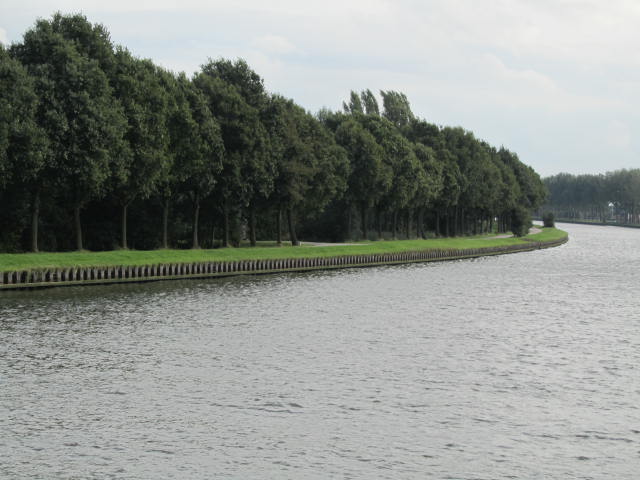
Under dreary and often drippy skies we cruised through the Rhine Gorge, where the river runs deep and fast through steep slopes on both sides. This is the area where you find castle after castle, first on the left, then the right, and repeat all the way to Rudesheim. Around 11AM, as if we hadn’t consumed enough and though it was only Friday, the chef presented a tradition Sunday snack: sausages of various types, sauerkraut, bread, and, of course, beer. The River Queen celebrated passing the Loreley rock by offering passengers a special blue alcoholic beverage, concocted from Prosecco and probably Blue Curaçao. Around 3pm, we finally arrived in Rudesheim.

We hopped aboard the local tourist train and headed for Siegfried’s Museum of Mechanical Musical Instruments. I had expected something less than it turned out to be. It has a collection of mechanical instruments, some as large as pieces of furniture. We started out with a mechanical banjo, made by a company in Chicago. Several pieces even featured the sounds of a full orchestra. In the grand hall of the 16th century original house (Bromerserhof), they featured a player piano played by a paper roll. There were a collection of organs, from carousel rides; a gramophone, and other assorted instruments. The wood inlay and carving of the pieces, as well as the painting on the painted pieces, was notable. One instrument even had two rounded chambers in which were mounted 6 violins. Only one string on each violin was played and the six violins revolved in the chamber as the piece was played. Siegfried starting collecting these instruments over 50 years ago and none were operable. He has founded a workshop and the trade continues today. An oddity that Siegfried collected was a pistol; and when the trigger was pulled,  a bird came out and tweeted/chirped like a real bird. Siegfried’s workshop makes little boxes that replicate the bird and it’s sound – it takes over 2 weeks to make one.

Once our tour was over, we strolled the Drosselgasse, a narrow (only 6 feet wide) street is lined with shops, cafés, and wine taverns over its 360 foot length. Drosselgasse means “Strangle Lane” – despite the rain, it was crowded with folks strolling down to the river.

We found the central square, quiet in comparison to the busy street we just left. At one end we found St Jakobus Church. Like so many of the towns we visited, Rudesheim was a Roman village. The original Roman fort became the foundation for the medieval Bromserburg castle, which is now a wine museum.

The town features a special coffee: sort of like an Irish Coffee, it is made with a locally distilled brandy called Asbach Uralt. It is usually served in a special cup and is often assembled right in front of you.

We did not take the funicular up to the monument to German Unity Monument, which was built in the 1870’s at the direction of Otto Von Bismarck. Rain and cold forced us back to the warm hospitality of the ship!

Posted in Boppard, Rudesheim | Tagged , , , , , | Leave a comment

Cruising the Moselle to Return to the Rhine

We left Bernkastel at 4 am, heading downriver on the Moselle, cruising all day and scheduled until midnight. After all the activities we’ve done all cruise have left us a little tired and the rest day aboard the River Queen is a welcome change. Many passengers chose to do laundry on this rest day and the line for the two machines was very long.

As we promised Fall color is coming to the region

As we promised Fall color is coming to the region

Our weather ran the gamut, from overcast and dreary, burst of welcome sunshine, to downpours. We even had a downpour while the sun was shining. This was the time to photograph passing scenery. Though photos can’t possible tell the entire story. Much of the time was spent watching the crew get us through the locks and watching the River Queen glide through the majestic countryside, where vineyards climb up the steep slopes, towns and villages dot the shore, sheep grazed, birds flew and hunkered down for the storms. The best views were from the top deck, though it was chilly up there. Two brave Canadians wrapped in blankets sat on deck with a bottle of wine and cheese and crackers for lunch. Brave souls.

We watch as the clouds begin to get angry over the river

We watch as the clouds begin to get angry over the river


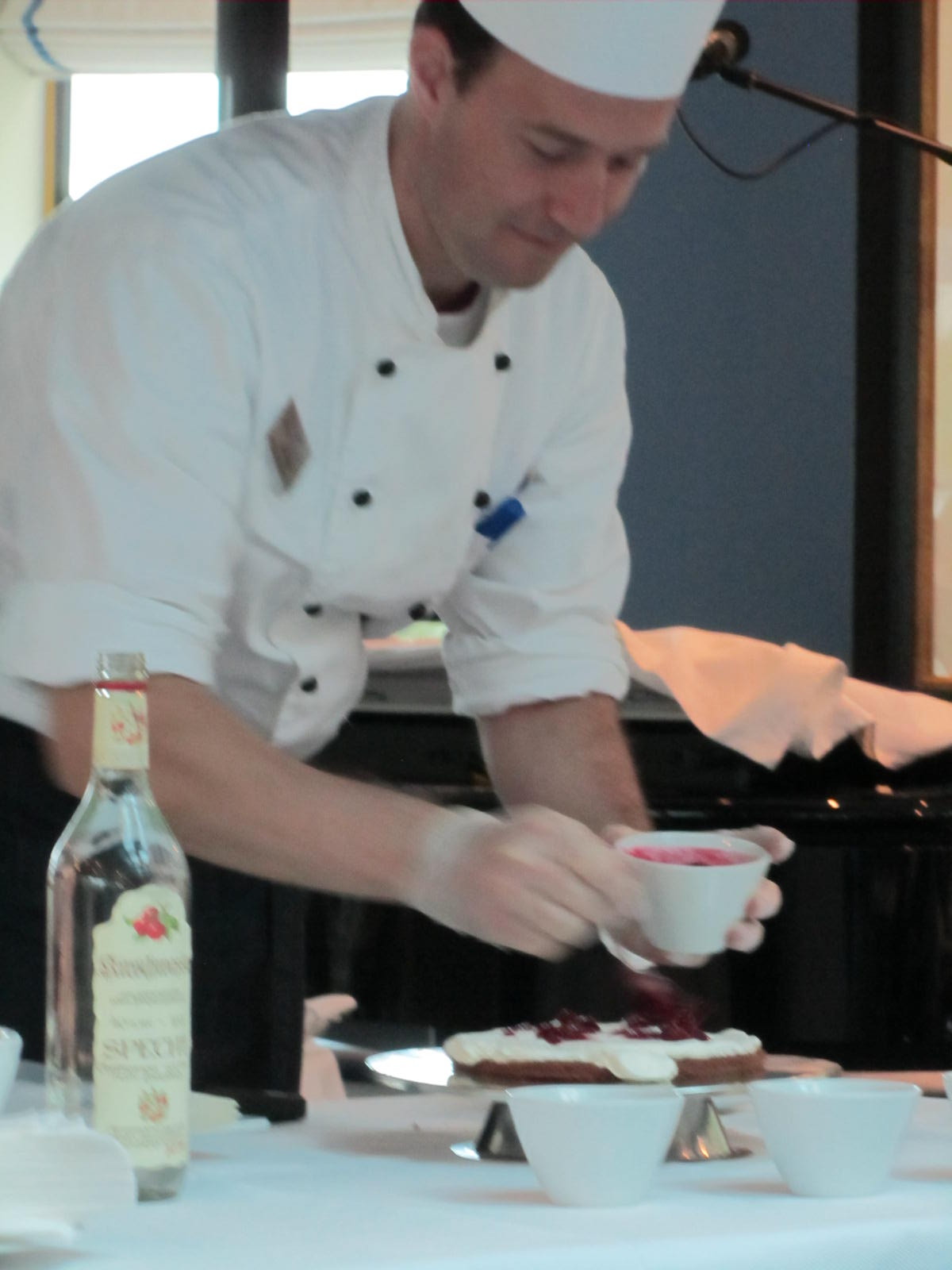
Food and drink were abundant. Our chef, Manuel, and pastry chef, Dimitri, gave a Black Forest Cake demonstration attend by Mike and lots of ladies aboard. Of course the rest of the men magically appeared where the cake was served for consumption.

There's anger in them there clouds - maybe even a few tails of beginning tornadoes - if we were in Kansas

There’s anger in them there clouds – maybe even a few tails of beginning tornadoes – if we were in Kansas

We were treated to a lecture by Martin, our cruise director, about the German personality and quirks – even though he is an Austrian.


We reached Boppard ahead of schedule, we were supposed to get there at midnight but we pulled in before dinner. We visited with other passengers all day, comparing notes on photos and lives, getting to know each other better. After a huge dinner, we planned our next days activities.


Chef Dimitri. pastry chef,  demonstrates how to make a Black Forest Cake

Chef Dimitri. pastry chef, demonstrates how to make a Black Forest Cake


Chef Manuel, chef aboard the River Queen, narrates the Black Forest Cake demonstration

Chef Manuel, chef aboard the River Queen, narrates the Black Forest Cake demonstration


Sunset on the Rhine after a ferocious storm

Sunset on the Rhine after a ferocious storm

Posted in Bernkastel-Kues, Ediger-Eller, Germany, Moselle River, River Cruise, River Cruising | Tagged | Leave a comment

Trier and Bernkastel Germany October 9 2013

The day started early and was planned to be a long day since one of the locks we were to go through was under construction. What that meant is that it would only open during specific hours during the day. So two days’ of shore excursions were melded into one, and tomorrow will be spent cruising the entire day. The morning started out – as usual overcast, but

 this time portending rain. Our guide from yesterday, Frankie Kahn, met us and entertained us with stories, facts, and the evolution of words in various languages.

Trier is Germany’s oldest town, named for an Assyrian prince who named it after himself (Treberis) somewhere around 2000 BC and over the years it evolved into its current name. In 16BC the legions of Julius Caesar set up an encampment here. At one point it was one of the four capitols of Europe, second only to Rome. At one point even Emperor Constantine made his home in Trier. As the home of a Roman Emperor, Trier was constructed with all the usual buildings: palaces, temples, amphitheater, public baths – and that is why Trier has more Roman ruins than anywhere north of Alps. Trier was the first per planned city. Its main roads run north/south and east/west. At the intersection, the Romans placed their forum. From that point a grid network of lesser ways was established with structures of lesser importance.

In current day, Trier is the home the largest manufacturer of Camel cigarettes, though owned by the Japanese Tobacco Co. International.

Along the way, we noticed that fall was coming to the Moselle Valley; leaves we’re starting to turn. Many of the older buildings of Trier were converted monasteries and cloisters in medieval times that recycled the walls and building materials of the Roman city.  In fact, the Roman city was twice the size of the Medieval city. Many advances of the Romans were discarded in Medieval days and not reintroduced until the early 1900’s like indoor plumbing, etc.  Only one of the three Roman bridges crossing the Moselle is still standing. During WWII, the allied forces released war prisoners housed nearby and together they were able to prevent the Germans from blowing up the bridge.

We headed to the earthen work amphitheater, so we drove across the top. Archeologists believe the amphitheater held almost 20,000 citizens, and hosted activities like Roman amphitheaters across the old Roman Empire. We got panoramic view of the city from there, including the amphitheater below and the Roman baths. A church dedicated to St Matthias is found here, a destination for pilgrimages throughout Christian history. In case you are not familiar with St Matthias, he is mentioned once in the Gospels – he was chosen to replace Judas. Trier is also the birthplace of Karl Marx, the founder of modern socialism. The house in which he was born features a signed first edition of Das Kapital.

Our walking tour began at the Porta Nigra, the Roman City gate constructed of sandstone and among the last remnants of the wall that used to surround Trier. We visited the city’s old Jewish quarter.

We visited the Imperial Roman Emperor’s Throne Room, all that’s left of the 306 AD Emperor Constantine’s Basilica, an impressive handmade brick structure, that proved over time to be highly resistant to destruction. Over time the structure gave way to other purposes and groups would try to expand the structure by taking down walls. However they found that extremely difficult. In fact, only two original walls are intact. In Roman times, the structure was heated with a complicated radiant heating system, the floors covered with black and white marble including Carrera from Italy, the walls with a reddish-purple marble or stone from Tunisia.  Today the structure houses the city’s Protestant church. We ventured on to the square where the monumental cathedral (St Peter’s Dom) stands next to a simple?? Parish Church of Our Lady. The cathedral is said to be house the Holy Tunic, the robe said to be worn by Jesus at the crucifixion.

By now, the sun was peeking through the clouds, so we searched the market square for a Rathskeller to enjoy lunch out on a terrace. After lunch, we returned to the bus and headed to Bernkastel. On the way, Frankie discussed winemaking and various vineyards and wineries along the Moselle. We stopped at on overlook to see an entire bend in the Moselle and the village or town enclosed in the bend. By now the overcast skies were back!

Bernkastel is the most picturesque town we have encountered. Bernkastel is on the north bank of the river; the town of Kues on the south. The bridge between the two was built in the 1900’s. In terms of governance, the two operate as one. The castle at Bernkastel is in ruins at the top of the hill, the Castle Landshut built in 1277 and burned in 1692. The most interesting site in Bernkastel is the Marktplatz, an ideal medieval town square with tall half-timbered houses with carved facades with shops on the street level. At one end is the town hall or Rathaus, center of government. In the center is a 17th century St Michael’s fountain, which during the annual September wine festival flows with wine. One of the town’s original gates still stands. Nearby we found the Doktorkeller, the best of the wineries here locally, known for its fine wine and the wine that gave rise to the legend. Legend: hundreds of years ago, the archbishop was ailing and failing fast. Local physicians were unable to help him get better. The archbishop was given wine from this small vineyard and he was brough back from the brink of death and he declared the wine his doktor. Doktorkeller means Doctor Cellar. Our guide led us to the Dr. Pauly-Bergweiler winery where we tasted four Moselle Reislings. All were pretty sweet and not to my liking, though I did drink the entire tasting of the fourth, the sweetest, since it was the pride and joy of the family.  We wandered the town, I purchased a glass Christmas ornament of a bottle of Moselle wine made exclusively for a shop in town. I had to choose between a cuckoo clock ornament and a bottle of wine ornament – I let Mike choose. We strolled on to the River Queen, boarded and stayed on board for dinner and the night. We were scheduled to castoff at 4 in the morning.


Posted in Bernkastel, Trier | Tagged , , , , | Leave a comment

Luxembourg October 8, 2013

We were still underway in the morning, cruising the winding Moselle, with its steep vineyards and quiet villages under, of course, overcast cloudy skies. All in all a leisurely morning!

After lunch, we boarded a bus for our trip through the countryside to Luxembourg, the city in the Duchy of Luxembourg. One of the smallest sovereign nations in the world, Luxembourg is the founding Capitol of the European Union, begun in the fifties as a result of a commodity agreement (coal and steel) between France and Germany. Luxembourg is the site of the European Central Court System. It is wealthy area with its wealth based mostly in its financial sector, with prestigious banks from across Europe present. It is also corporate headquarters of Amazon and Skype, among others. Due to American tax laws, Luxembourg banks will not accept deposits from Americans – unless they show up with a suitcase filled with 50,000 euros.

We traveled through the suburbs of the city with its contemporary architecture and mostly financial businesses. We went into old town to the city center, stopped at the statue perched on an obelisk, visited the Cathedral of Notre Dame, the Palace of the Grand Duke, passed the Hotel de Ville. Our tour of the city center streets ended with a glass of Cotes-de-Provence rose in the square overlooking central shopping. Luxembourg currently has brightly painted elephants around town which be auctioned off to raise funds for a save-the-elephants foundation. Our tour guide was from Arkansas, married to a German professor. Much of her discussion concerned the history and evolution of language and how Luxembourg has successfully integrated French, German, and the Luxembourgese through their educational system.   We saw the Luxembourg allocated gardens the equivalent of community gardens in US – but they seemed a little neater and better tended. We saw case mates (historic castle battlements) and the millennium memorial installed by the city to commemorate its 1000 anniversary in 1963 on the site of subterranean tunnels and barracks, which are designated as a UNESCO World Heritage site. It was founded in 963, on a rocky promontory by Sigefroid, Count of Ardennes. Due to its location and strategic position, it has been controlled by Spanish, Austrian, French, and Prussian forces.

Our next stop should have been the WWII cemetery in Luxembourg, but due to the US government shutdown, the cemetery was closed. More than 5,000 military dead are buried here, many from the Battle of the Bulge. General Patton, himself, is buried there rather than Arlington National Cemetery, since he wanted to be buried with his men.

Posted in Battle of the Bulge, European Central Court, Luxembourg, WWII cemetery in Luxembourg | Tagged , , , , | Leave a comment

Cochem Germany October 7 2013

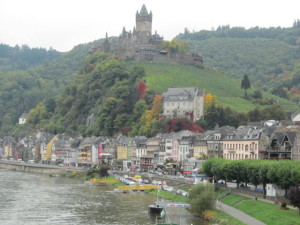
The castle, the Reichsburg or Emperor's castle, sits high on a hill overlooking the town of Cochem and the Moselle River

The castle, the Reichsburg or Emperor’s castle, sits high on a hill overlooking the town of Cochem and the Moselle River

Cochem and Ediger-Eller Village Monday, October 7, 2013

After sailing all night, the River Queen arrived in Cochem shortly after 7 am. It’s another cloudy overcast day and the photographs suffer! But, in real life the views are breath-taking.

Cochem is on the bank of the Moselle River with all it’s twists and turns. The Moselle is known for its castles, picturesque countryside, and most of all its vineyards producing rich full-bodied wines. A succession of wars and conflicts left marks of destruction on many of the fortress-castles. Back in the late 17th century, King Louis XIV, the Sun King of France, almost completely destroyed the 11th century Reichsburg Castle. Reichsburg means Emperor’s Castle and has nothing to do with the third Reich. We visit the castle today, restored by private funds from a very wealthy man and now the property of the city.

Our guide for the tour was Klaus, an engaging, witty, man with a mustache, wearing a “cowboy” hat. Klaus has retired from his position as police chief and now serves as tour guide and actor.  On the way up the hill to the castle, he mentioned we were passing the school. Further he mentioned in this school they have mandatory physical education. The buses drop the students at the bottom of the hill and they must walk up the steep incline every day. Reichsburg Castle, a Gothic castle, looms more then 300 feet above the Moselle, accessible by winding your way up a series of switchbacks. It was built in the 11th century. Not the largest nor oldest castle, but with its towers and spires soaring over the town, it is stunning. Reichsburg was restored by the Ravene family who purchased it in 1868. Several interior rooms are furnished with Renaissance and Baroque furniture and those rooms we visited. On one of the exterior towers, a large painting, mosaic of St Christopher, patron saint of travelers, was added after WWII. The original had been removed by the Nazis.

Our guide escorted us down to Cochem itself to continue our tour. Klaus brought the history of Cochem to life as we wandered narrow alleys and streets lined by half-timbered houses, viewed the vineyards surrounding the town, saw Endert Gate, built in 1630, and the Pegel House where they have recorded the depths of river floods over the years. Crossing over the bridge we returned to the River Queen for lunch.

Insert town photo gallery

Today’s agenda includes a visit to the village of Ediger-Eller, formerly two settlements combined into one village. To get there we take a scenic drive along the Moselle to this winemakers village, passing precipitous slopes covered in vineyards. This are boasts the steepest vineyards in all of Europe.

As we left the bus, we were greeted by the mayor, and his guard (his brother by the way) dressed in medieval garb. The mayor guided us through his town, telling us about the half-timber houses, when they were built and who owned them. At the central square, where the tourist office is located, townspeople have marked the depths of river floods on the exterior wall. We strolled by the Jewish synagogue, though the only Jewish resident, a lady, lives in NY. She visits once a year for a couple of months, owns a house here and is considered a resident. We continued on to St Martin’s Church, which dates to the 16th century. It’s bell tower is considered the most beautiful Gothic spire along the Moselle, as well as the most richly ornamented slate roof.

Inside the Church, we were treated to an organ concert by Mr. Daniels! Perhaps a long lost relative? Insert Ave Maria recording here. From there we clambered up the hill behind the church to the beautifully cared for cemetery with its memorial to those lost to the concentration camps.

Back down the hill to the Mayor’s tavern for a wine-tasting and some snacks. We were introduced to some dry Reislings crafted by Stephanie from her vines spread over 13 plots of land. Her two delightful daughters served wine as their mother explained the vintage. Between tastes, the multi-talented mayor would sing German folk songs accompanied by his uncle on the piano. Before the fun ended, our host showed us a black and white film, made in the 50’s, showing life in the vineyards at that time. It was a hard life, climbing the steep slopes, harvesting grapes in flat-backed containers on your back (many now planters in town at the front door), children started work young.

We returned to the River Queen, just in time for cast-off at 6:00 pm. After a Moselle Epicurean cocktail in the lounge, an Epicurean dinner with regional specialties was served, followed by music in the lounge. We are underway to Schweich and will arrive there Tuesday around 11am.

Posted in Cochem, Ediger-Eller, Germany, Moselle River | Tagged , | Leave a comment

Koblenz Germany

Koblenz is a town that sits at the confluence of the Moselle and Rhine Rivers. It is here that the River Queen bears right and heads up the Moselle, a river full of bends and twists.

This lovely plump bathing beauty greeted us as we pulled into the dock at Koblenz

This lovely plump bathing beauty greeted us as we pulled into the dock at Koblenz

After breakfast, we boarded a bus to tour Alken and Thurant Castle. We drove along the Moselle’s river bank, past a couple of small towns, past terraced vineyards, to the Thurant Castle. We all got a thrill when the bus driver made a left turn at such a sharp angle that we thought he was turning onto a cattle path! We climbed a hill with a fabulous view over the town and river to the castle itself.

Built as a fortress between 1198 and 1206, and expanded between 1246-48. It was divided into two halves by a wall, each with a keep or tower, by the two feuding archbishops of Cologne and Trier. The castle fell into disrepair and was acquired by the Allmers family in 1911. Since 1973, the castle has been jointly owned by the Allmers and Wulf families. The castle consists of caretaker’s quarters (a post and beam building), a Steingarten (garden carved out the rock and stone walls), the Trier Tower (20 metres high, which now serves as water storage), the Manor House (destroyed in WWII but rebuilt by Irmgard Wulf-Allmers in 1962), a guest house (rented by the week very reasonably), a chapel with its ceiling painted blue and decorated with stars containing a stained glass window of St Michael, a rose garden with some still blooming that has been in place since Medieval times, a wine cellar with winemaking equipment from the 19th century, the Cologne Tower complete with a dungeon and torture equipment, and the Hunters Quarters fitted out with game trophies, armor, etc.

Our hosts at the castle served us a glass of white wine and this knockwurst

Our hosts at the castle served us a glass of white wine and this knockwurst

Before we descended into town, our hosts at the castle provided us a glass of white wine and a knockwurst. The descent to town was steep, through the woods, through the vineyards to the quaint town of Alken and its Church of St Michael, with its ossuary of bones from the 1400’s when the cemetery became overcrowded. We boarded the bus and headed back to the River Queen in Koblenz.

Grapes on the vine as we descended into Alken from Thurant Castle

Grapes on the vine as we descended into Alken from Thurant Castle


through the woods on our way to the vineyard below the castle

through the woods on our way to the vineyard below the castle


Germany is beter known for its white wines from grapes like these that we saw descending from the castle

Germany is beter known for its white wines from grapes like these that we saw descending from the castle


After a light lunch aboard the River Queen, we strolled through Koblenz to find the Deutsches Eck (German corner where the rivers meet with its monument to Kaiser Wilhelm I), sneaked a peak at the Ehrenbreitstein Fortress across the river, watched the funicular cross the river. We found St Kastor’s Basilica, a market, and pretty little squares (despite the fact that 90% of Koblenz was destroyed during WWII). We also discovered a few fountains scattered about town, town hall and Jesuits’ Square with its Jesuit Church. Koblenz celebrated its 2000th birthday in 1992, originally a Roman settlement named Castrum ad Confluentes. The town’s power and influence grew in the Middle Ages due its location and its ability to control trade on both rivers. Europe’s largest fortress, Ehrenbreitstein, was built in the 12th century.

gallery of Koblenz photos (see above)

Back to the River Queen for cocktail hour and dinner. After dinner, we listened to music by Florina and Tony in the lounge and at 10 PM we were casting off. The dock/pier in Koblenz is near a residential area and the town council passed a regulation that went into effect that boats must move away from dock by 10 PM or shut off their engines and connect to shore power to reduce the noise. Uniworld had always left around 10 anyway to make it to the next town, Cochem.

We stayed on deck to watch the casting off process. A boat, rather large, had tied off to us so their passengers could go ashore across our boat. Based on the captains actions when the boat came in we expected quite a show. It didn’t happen. We stayed topside to watch the crew take us through the lock at night. Quite a show!


Posted in Germany, Historic Sites and Monuments, Koblenz, River Cruise, River Cruising | Tagged , , , , , , | Leave a comment

Cologne or Koln

Sometime about 1:30 AM, we entered another lock on the Rhine River. It didn’t bother us, but folks at breakfast mentioned bright lights in their window and bumping and swirling.

We woke to a grey day, overcast and threatening. A visit to the fitness center was first on the schedule for me, then breakfast. We met some interesting folks at breakfast and Mike regaled them with tales of our barging trip through Burgundy and the locks we encountered on the Soane, the Little Soane, and Seille Rivers.

Later in the morning, we listened to a lecture on the Roman influence on the development of Germany. We approached Cologne (Koln) shortly before noon. From our vantage point at the restaurant, we watched as the crew worked to secure us to the wall.

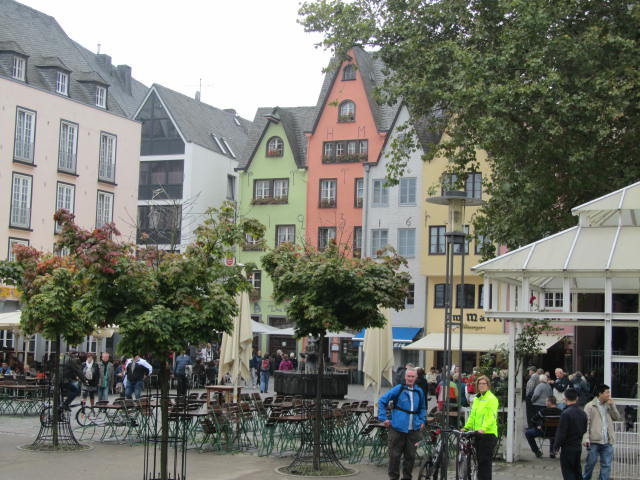
One of the tiny squares in Cologne

One of the tiny squares in Cologne

Cologne is the largest city of Rhineland. The featured guided tour took us through squares in the oldest part of town, past oddities like unique rain spouts, down narrow streets and tiny squares. Our guide, Parthena (of Greek heritage), was engaging, very knowledgeable, and fun. She showed us newly discovered remains of a Jewish Synagogue and a Mikvah, currently being analyzed and studied. The town hall was built with a steeple like a church and featured statues of notables who had lived or visited. One was an Archbishop who wanted to be duke, but townfolk drove him out of town preferring a secular government. Of note, is the fact that pedestal holding his statue is a “moon.”

A tongue in cheek slap at the archbishop who wanted to be archduke at the Cologne town hall

A tongue in cheek slap at the archbishop who wanted to be archduke at the Cologne town hall


City fountain in the center of the square

City fountain in the center of the square


Farina, a Italian who moved to Cologne, is credited with inventing eau de cologne. Scents previously had been oil based, he chose alcohol as his base, mixing it with bergermot, iris, and citrus. One significant advantage was that an alcohol based scent would not stain fine silk fabric. Among his famed customers were Marie Antoinette and, even, Bill Clinton.

Digging for a new subway unearthed significant archeological sites dating to Roman time

Digging for a new subway unearthed significant archeological sites dating to Roman time

Our engaging delightful guide on our walking tour of CologneOur engaging delightful guide on our walking tour of Cologne, encouraging us to rub the nose of this bronze statue so we would return to Cologne

We walked on to Domplatte (Cathedral Square). First stop at the square was the Roman-Germanic Museum which exhibited relics to exemplify the history of Romans along the Rhine. The museum was built on the walls of Roman villa that was discovered in 1941. Exquisitely preserved is a mosaic of Dionysus that was the dining room floor. There were relics of every day life including: tombstones, arches, pottery, glass, and jewelry. Glass-blowing was an technique the Romans brought that took advantage of the natural materials of the area. An arch that has been displayed in the museum is the original arch for Colonia Claudia Ara Agrippinensium (the Roman name for Cologne, which was the capital of Lower Germania.) The mosaic floor was originally more intact, but a storm in 2007 drove lumber/boards through the windows and damaged sections that now appear as plaster sections with no features.

This floor was uncovered in 1941 an dis a mosaic floor of a dining room that dates to Roman times. It has achieved world-wide fame as Dionysis Mosaic

This floor was uncovered in 1941 an dis a mosaic floor of a dining room that dates to Roman times. It has achieved world-wide fame as Dionysis Mosaic

We left the museum and headed over to the Kolner Dom, the Cologne Cathedral. It is the largest cathedral in German,y, took over 600 years to build. Foundation laid in 1248, but after approximately a third was completed, construction ceased and did not start again until 1842. It was completed in 1880. Much of the stained glass is intact, surprising considering 95% of Cologne was destroyed in WWII. Photos were not permitted in the cathedral, as It was Saturday, the time for confessions.

Shoe and Carol at a sidewalk Bistro

Shoe and Carol at a sidewalk Bistro

Most of the exquisite stained glass is intact as well. We were told during WWII, it was removed to be preserved. According to lore, the church was built to accommodate the relics of the Three Wise Men. They are housed in a gold sarcophagus decorated with rubies and emeralds. The relics are only displayed on January 6th, complete with crowns.

MIke and Pat at a sidewalk bistro in Cologne

MIke and Pat at a sidewalk bistro in Cologne

We walked down a shopping street, found a sidewalk eatery to have a beer, then strolled back to the River Queen. We sat topside, chatting about our day, waiting for dinner service to start at 7PM. Dinner was exquisite and then to bed to prepare for the next day’s activities!

Cologne

Cologne

Clock tower on town hall

Clock tower on town hall

This is the shopping district where at the MediaMarkt, Mike purchased an adapter to permit us to upload photos

This is the shopping district where at the MediaMarkt, Mike purchased an adapter to permit us to upload photos

Posted in Cafe, Cologne, Crusing Guide, Germany, Historic Sites and Monuments, Museums | Tagged , , | Leave a comment

Casting Off From Amsterdam

We were up bright and early, well early anyway. I guess it was bright every time lightening struck. Weather didn’t dampen our spirits a bit. After a sumptuous buffet breakfast in the dining room with choices of cereal, fruit, yogurt, scrambled eggs, bacon (soft or crispy), made-to-order omelets, a vast spread of bread and rolls, we geared up with hats, coats, and umbrellas for our morning tour of Amsterdam by canal boat.

a boat along on canal boat tour

a boat along on canal boat tour

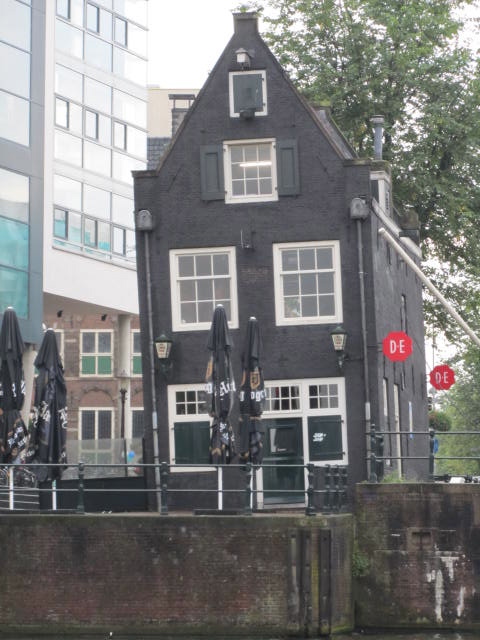
We had walked these canals (Prinsengracht, Keizersgracht, and Herengracht) earlier in our stay and it was great to see them from another perspective.

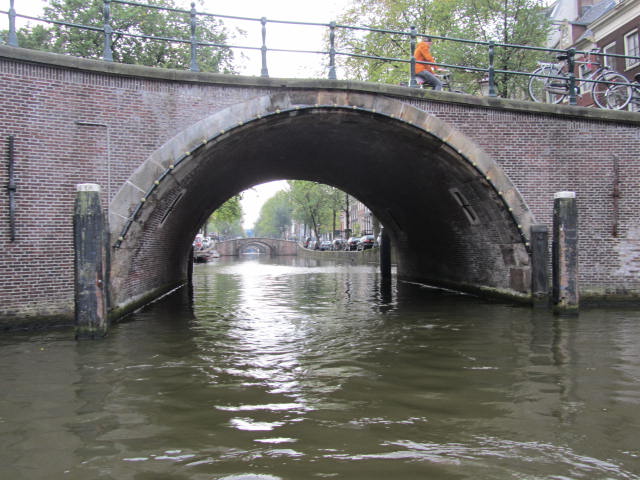
These humpback bridges cross Amsterdam's canals lending a sense of charm

These humpback bridges cross Amsterdam’s canals lending a sense of charm

Earlier we watched a canal tour boat make a sharp right turn from a little canal into one of the bigger canals. The maneuvering was exact, check for oncoming traffic, pull across the canal, back up using thrusters and turn the bow into the new canal. Now here we were doing the same thing.

A canal toll house in Amsterdam

A canal toll house in Amsterdam

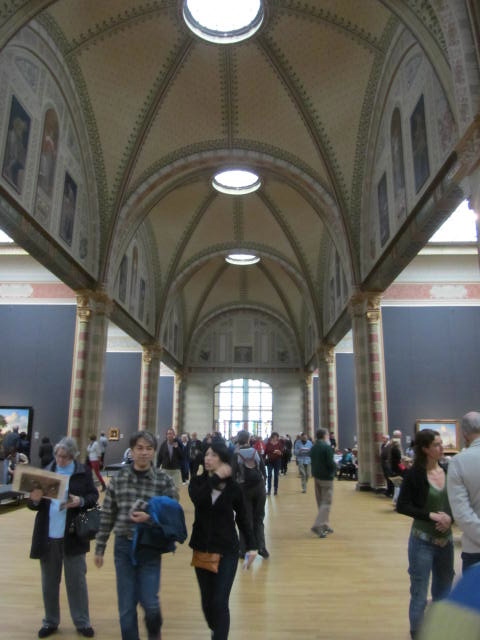
After our canal tour we headed to the Rijksmuseum, the Netherlands premier museum, with a superb collection of of works from the 17th century Dutch Golden Age. It had undergone a 10 year refurbishment and to announce its re-opening, the museum held a flashmob-type event featuring characters from Rembrandt’s “The Night Watch.” I loved the video and wanted to make sure I saw the original work.


The exquisite interior of the Rijksmuseum home of works by Rembrandt, Vaermeer, etc.

The exquisite interior of the Rijksmuseum home of works by Rembrandt, Vaermeer, etc.


We viewed works by all the Dutch Masters, Vermeer included. Unfortunately “The Girl with the Pearl Earring” is in The Hague. The museum also houses a fine collection of silver, furniture, and porcelain. On our way out of the museum, we caught sight of two “doll houses”, miniature fully furnished canal houses – completely decorated!


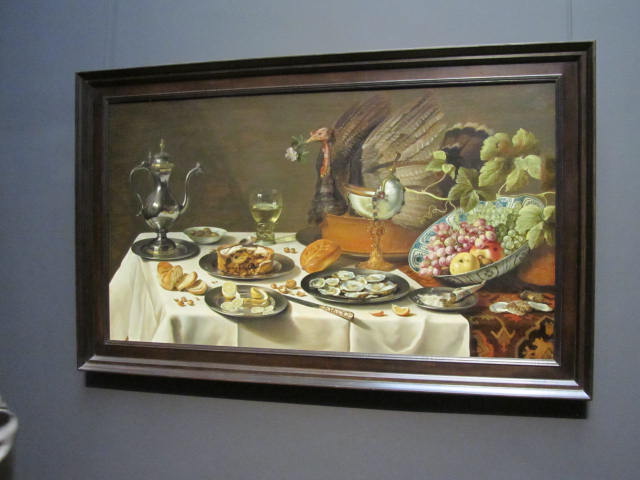
Who's painting is this?

Who’s painting is this?

It was now after one o’clock, cast of time was scheduled for one. We hurried aboard and as the last person stepped off the gangway – the crew broke it down. Now it was lunch time: a buffet of local and regional favorites, with wine included.


magnificent chest in the Rijksmuseum

magnificent chest in the Rijksmuseum


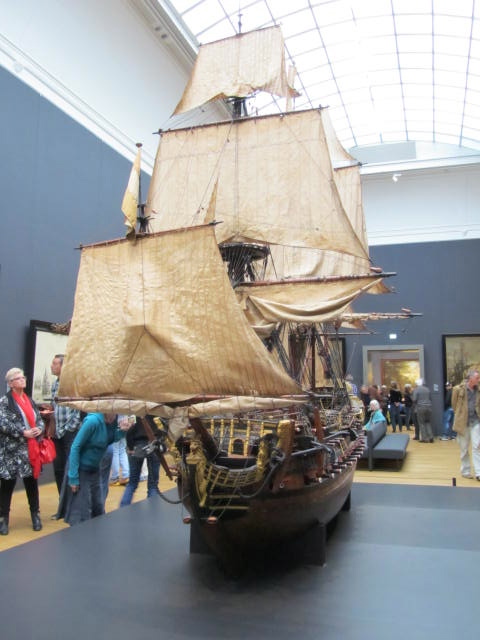
Model Sailing Ship at Rijksmuseum in Amsterman

Model Sailing Ship at Rijksmuseum in Amsterdam

As we dined, we watched from the stern dining room as the River Queen made her way out the river. A quick change of clothes, a visit to the fitness center, then topside to sit in the sun.


The daily briefing was very long today, with our guide briefing us with what we will find throughout the entire trip. Around 5 pm, we approached our first lock – it was great to be able to watch and not have to jump off and catch the lines, have Carol throw me the lines, Shoe on the bow getting soaked, and Mike at the helm!


We're finally underway along the legendary Rhine River - albeit under overcast skies

We’re finally underway along the legendary Rhine River – albeit under overcast skies

Tonight was the Captain’s Welcome with sparkling wine at 6:30 PM. Our captain is young but grew up on the river and seems very capable. Just before 7PM we entered our second lock and, once through it, we were on the Rhine River. We will cruise for 18 hours between Amsterdam and Cologne, our next stop.  After dinner, we listened to Csaba in the lounge playing tunes from the 50’s.

Posted in Amsterdam, Museums, River Cruise, River Cruising | Tagged , , , , | Leave a comment

Boarding the River Queen

After breakfast at Hotel Bellevue, we gathered up all our belongings and caught a taxi to the dock where the River Queen had arrived earlier. We knew we would not be able to access our stateroom, but we definitely wanted to dump our bags.

We were initially somewhat confused as the River Queen was docked alongside another riverboat. An very hospitable Uniworld gentleman assured us we were at the correct place and took off with our suitcases. Ahem, was this for real?  We clambered aboard the boat, followed our guide to another boat and checked in at the desk. We could stay aboard all day – but why waste time?

Our Room on the River Queen

Our Room on the River Queen

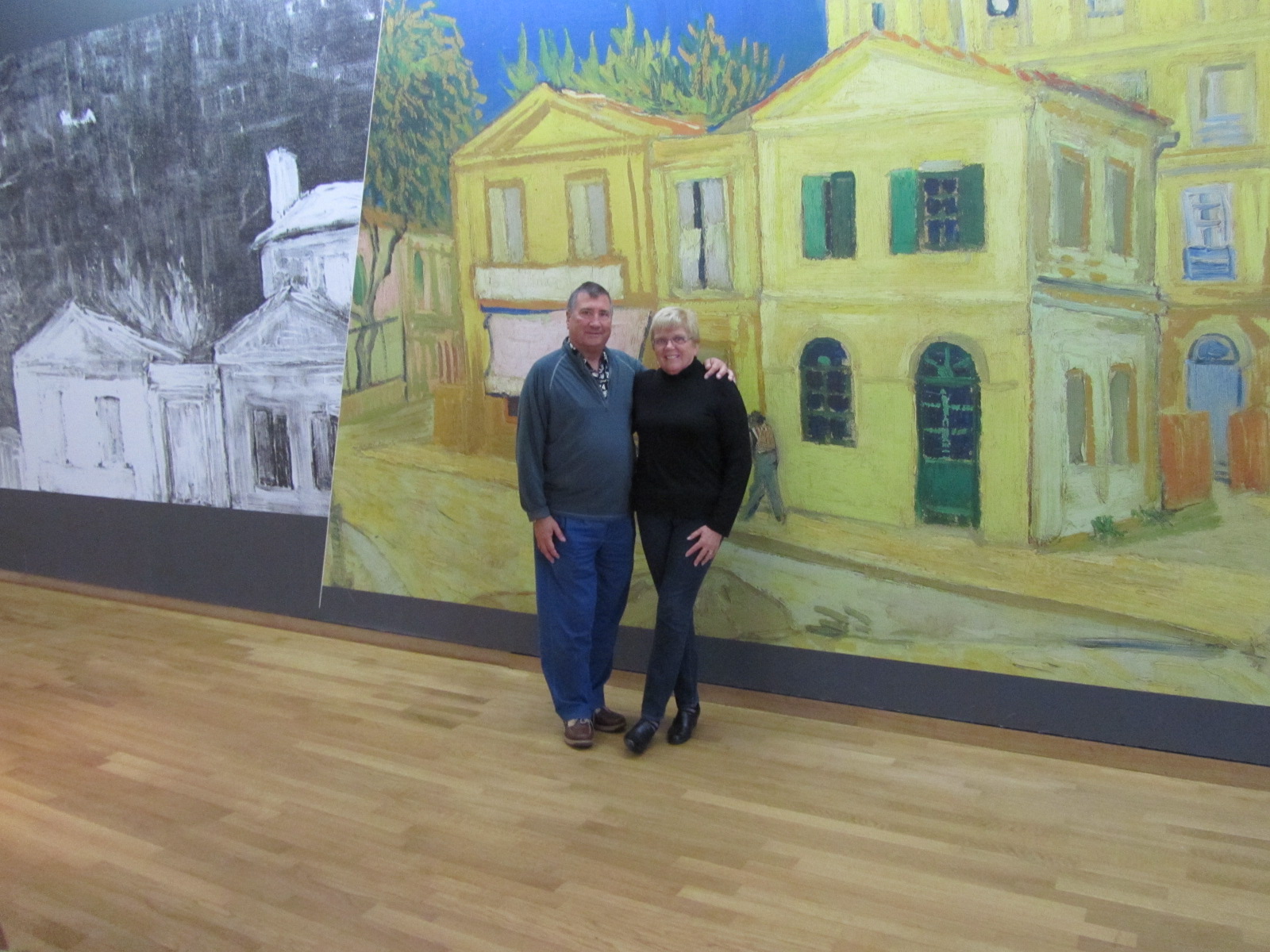
We caught a taxi and headed for the Van Gogh Museum. We arrived shortly after opening and spent a couple of hours viewing the collection, learning about Van Gogh’s use of color and technique and which artists inspired him. We visited all three floors of paintings,

Our Visit to the Van Gogh Museum in Amsterdam

Our Visit to the Van Gogh Museum in Amsterdam

watercolors, and sketches. While Van Gogh is not my favorite artist, the collection of this museum is extensive and everybody can find at least one work they like.

We were now approaching lunchtime and boarding the River Queen was technically not until 3 PM. So we decided to walk from the museum back up to the river and the dock. We took a circuitous route from the Museumplein, trudging up Vizelstradt toward City

Flows along a bridge of the canal

Flows along a bridge of the canal

center. Our route took us on some streets we had not traveled previously, but on some we had passed before. We traveled through Dam Square in search of a cafe for lunch. Lunch was tostis all around, those toasted sandwiches the Dutch love. And, maybe a beer for each of us!

After lunch we hit the red light district on our way back to the dock where the boat was moored. Since it was early afternoon, it was fairly sedate and sleepy.The Dinning Room on Board

We boarded the River Queen a little after 3pm, checked into our cabins, unpacked and stowed our belongings, and explored the vessel to get our bearings. Around the magic evening hour, we went to the bar/lounge for a glass of wine. At 6 pm we were subjected to the indignity of an emergency drill which was followed by tour rules and a tour briefing.

Dinner began at 7 pm, open seating, no forced friendships. The dinner was wonderfully prepared: a seafood cocktail with shrimp, soup, fillet of sole with tomato polenta, and: for dessert, coffee and either a napoleon or chocolate ice cream.  After dinner we retired fairly early since tomorrow is an early day.

On the upper deck of the River Queen.

On the upper deck of the River Queen.

Breakfast at 7 AM, begin the tour at 8:40 am with a canal cruise and a visit to Rijksmuseum. Sleep well!

Posted in Amsterdam, Bistros, Cafes, Brasseries, Historic Sites and Monuments, Museums | Tagged , | Leave a comment

Amsterdam to Basel


Day 1:

Amsterdam (embark)
Arrive at Amsterdam Schiphol Airport where you will be transferred to the ship. (D)

Day 2:

Amsterdam
Featured Excursions: Amsterdam city tour with canal cruise and choice of Rijksmuseum OR Van Gogh MuseumExperience the highlights of Amsterdam with a city tour, and get a close-up view of the city’s waterways with a canal cruise. Choose between one of the most prestigious museums in the world—The Rijksmuseum, which offers the world’s largest collection of Dutch and Flemish art and artifacts, including Rembrandt’s The Night Watch and Vermeer’s The Kitchen Maid—or the Van Gogh Museum, home to the largest collection of his paintings in the world, including Sunflowers, along with the works of other 19th-century painters. (BB, L, Captain’s Welcome Gala)

Day 3:

Cologne
Featured Excursion: Cologne walking tour with Roman-Germanic MuseumStroll through the streets of Cologne’s Old Town to the fascinating Roman-Germanic Museum, which displays thousands of artifacts of dating from Cologne’s days as a Roman colony. (BB, L, D)

Note: On Mondays, the Roman-Germanic Museum is closed; it will be replaced with a visit to UNESCO-designated Cologne Cathedral.

Day 4:

Koblenz
Featured Excursion: Koblenz walking tourAmble through Koblenz’s picturesque Old Town, learning from your guide the town’s history and its importance to this region where the Rhine and Moselle rivers meet. (BB, L, D)

Day 5:

Cochem (Ediger-Eller)
Featured Excursions: Cochem walking tour with Reichsburg Castle and an exclusive Ediger-Eller wine tastingHistory comes to life in Cochem’s half-timbered houses and Gothic Reichsburg Castle. Enjoy a guided tour of the castle, followed by a walking tour through Old Town. Later in the day, you will take a motorcoach to Ediger-Eller, where you will be greeted by the town mayor, who will act as your host for the duration of your visit. Stroll with the mayor through the cobblestone streets to the church for a short organ recital. Then join the mayor for an exclusive wine tasting, where you’ll savor three wines along with a special snack prepared just for you at a
local inn. (BB, L, D)

Day 6:

Cruising the Moselle River, Trier/Konz (Luxembourg)
Featured Excursion: Luxembourg and WWII cemeteryFollowing a scenic morning sail on the spectacular winding Moselle, guides will show you highlights of the independent sovereign state of Luxembourg, including Our Lady Cathedral, the Grand Ducal Palace, and a WWII cemetery that is the final resting place of US Army General George Patton. (BB, L, D)

Day 7:

Trier/Konz, cruising the Moselle River, cruising the Moselle River
Featured Excursion: Trier city tourExplore UNESCO-designated Trier, once known as the second Rome. No other city in Germany has so many monuments from Roman times. See the Roman Imperial Baths, the Porta Nigra, and Emperor Constantine’s Throne Room. In the afternoon, sail the Moselle River, home to some of the world’s most delicious Riesling wines. (BB, L, D)

Day 8:

Bernkastel, cruising the Moselle River, cruising the romantic Rhine River
Featured Excursion: Bernkastel walking tour with exclusive wine tasting at the Dr. Pauly-Bergweiler wine estateDiscover Bernkastel, with its more than 500 years of winemaking history, beautiful vineyards, and picturesque market square. Savor the area’s fine Rieslings at the renowned wine estate of Dr. Pauly- Bergweiler. In the afternoon, take in the ravishing scenery of Europe’s steepest vineyards, which line the banks of the winding Moselle River. (BB, L, D)

Day 9:

Boppard, cruising the romantic Rhine River, Rüdesheim
Featured Excursions: Guided Boppard village stroll and Siegfried’s Museum of Mechanical Musical InstrumentsTake a guided morning stroll through delightful Boppard before cruising the scenic 40 miles of the Upper Middle Rhine Valley, a UNESCO World
Heritage landscape. With its vine-filled slopes and its 40 or so castles strung like pearls along the river banks, this is the perfect example of the romantic Rhine. In Rüdesheim, visit Siegfried’s Mechanical Music Cabinet, a small museum showcasing a unique collection of self-playing musical instruments. (BB, L, D)

Day 10:

Speyer
Featured Excursion: Speyer walking tourBe guided through Old Town to the grand Speyer Cathedral, a UNESCO World Heritage Site. The first churches in the city date to the sixth century, and the foundation for the cathedral was laid in 1030. It was also home to a thriving Jewish community in the Middle Ages, traces of which can be seen in a ritual bath and the remains of a synagogue. (BB, L, D)

Day 11:

Strasbourg
Featured Excursion: Strasbourg by canal with Notre Dame CathedralAdmire picturesque Strasbourg as you traverse its canals on your way to the gorgeous Gothic cathedral. You will feel like you are in a fairytale as you glide among the city’s beautiful half-timbered houses. (BB, L, D)

Day 12:

Breisach (Colmar or Riquewihr)
Featured Excursions: Choice of Colmar city tour OR Alsatian wine villagesVisit enchanting Colmar with its winding old streets, Medieval city center, and St. Martin Church, which is made of pink stone. Or choose to visit the picturesque wine villages of Kayserberg and Riquewihr. (BB, L, Captain’s Farewell Dinner)

Day 13:

Basel (disembark), transfer to the airport
Disembark the ship and transfer to EuroAirport Basel-Mulhouse-Freiburg for your flight home. (CB/BB)
Posted in Amsterdam | Leave a comment